Electric scooter charger: voltage, amps, fast charging and connectors
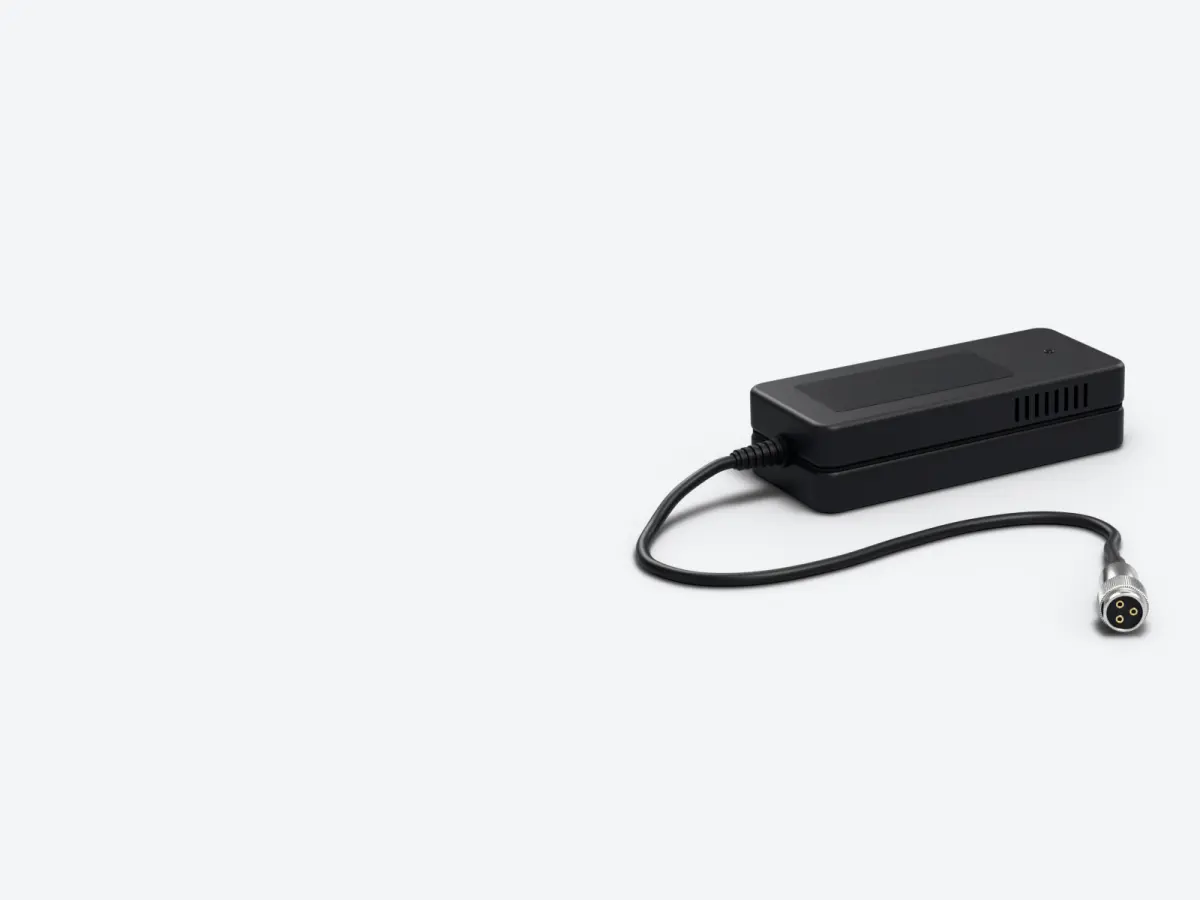
A charger's output voltage must be exactly the one intended for your battery, its current sets the charging time and its plug must match your charging port. Here is how to read the label, work out the charging time and spot a faulty charger.

Benjamin Gayaud
10 min read
Technical
A replacement charger? The same output voltage, to a tenth of a volt.
The essentials
You choose an electric scooter charger on three points. Its output voltage must be exactly the one intended for your battery, its current sets the charging time, and its plug must fit your charging port. The output voltage is that of the full battery: 4.2 V per cell at most[1], or 84 V for a 72 V battery with 20 cells, and 83 V on a Dualtron Thunder 3[2]. The charging time is worked out by dividing the battery's capacity by the charger's current.
4.2 V
per cell at the end of charging, according to the Molicel P42A data sheet
Ah ÷ A
the charging time calculation, plus the end of the charge
83 V
output of the Dualtron Thunder 3 charger, for a 72 V battery
1 min
plugged into the wall without the scooter, and the Minimotors charger goes into protection mode
- Read the Output line on the label: voltage in volts and current in amps.
- Match the exact voltage of the original charger: 66.4 V and 67.2 V are not the same charger.
- Charging time = capacity in Ah ÷ current in A, plus a little for the end of the charge.
- Fast charger and dual charging: only if your model's manual allows for them.
- Green light but no charging: the charger's protection may have kicked in. Unplug everything for more than three minutes.
How do you read an electric scooter charger's label?
A charger's label gives two sets of figures. The Input tells you what mains supply it plugs into, the Output tells you what it sends to the battery. The scooter's manual repeats the same values in its specifications table.
| What is written | What it means | Example taken from a manual |
|---|---|---|
| Input: 100-240 V ~ | The charger plugs into the mains, on alternating current (the ~ sign) | ‘AC100-120V/AC200-240V~’ for the Sonic Alien[3] |
| Output: voltage in V, DC | The end-of-charge voltage, in direct current. This is the one that must match your battery | 83 V for the Thunder 3 and its 72 V battery[2] |
| Output: current in A | The current sent during most of the charge. It sets the charging time | 1.5 A for the Thunder 3's standard charger, 5 A for its optional fast charger[2] |
| ± 1 V, ± 0.5 A | The tolerance allowed around the voltage and the current | ‘DC83V±1V/5A±0.5A’ for the Sonic Alien's fast charger[3] |
| Red light, green light | Charging, then charging complete | Rovoron R7[5]. On the InMotion RS, blue indicates power[10] |
The output voltage is always higher than the one written on the battery: 83 V for a 72 V battery. This is not a mistake, it is the full-charge voltage. Multiply it by the current to find the charger's power: 84 V × 5 A = 420 W for the InMotion RS charger[10]. Our voltage table gives the voltage of each battery class, from 0 to 100% charge.
Why must the charger's voltage match the battery?
A scooter battery is made of lithium-ion cells connected in series. The Molicel P42A cell data sheet describes charging in two stages, known as ‘CC-CV’: constant current first, then a constant voltage of 4.2 V until the current drops to 50 mA[1]. The charger's output voltage is therefore 4.2 V multiplied by the number of cells in series, or slightly less if the manufacturer decides so. The battery's nominal voltage, on the other hand, is counted at 3.6 V per cell[1].
| Cells in series | Usual name | Nominal voltage (3.6 V per cell) | Full charge (4.2 V per cell) | Chargers found |
|---|---|---|---|---|
| 10 | 36 V | 36 V | 42 V | 42 V for the 36 V Dualtron Togo |
| 13 | 48 V | 46.8 V | 54.6 V | 54.6 V for the Hero S8 and S9 |
| 14 | 52 V | 50.4 V | 58.8 V | 58.8 V for the Hero S10 and X8, 58.1 V for the Dualtron Aminia[7] |
| 16 | 60 V | 57.6 V | 67.2 V | 67.2 V from Teverun and Odyssr, 66.4 V for the Dualtron City[8] and the Rovoron R7[5] |
| 20 | 72 V | 72 V | 84 V | 84 V for the InMotion RS[10] and the Teverun 7260R, 83 V for the Dualtron Thunder 3[2] and Sonic Alien[3] |
| 23 | 84 V | 82.8 V | 96.6 V | 95.45 V for the Dualtron X Limited[4], 95.4 V for the Rovoron S7[9] |
The Dualtron and Rovoron manuals we consulted, from 52 to 84 V, stop charging slightly lower, at 4.15 V per cell: 58.1 V for 14 cells, 66.4 V for 16, 83 V for 20 and 95.45 V for 23. Two chargers sold for a ‘60 V’ battery can therefore put out 66.4 V or 67.2 V. Always match the exact output voltage of your original charger, written on its label or in the manual.
How long does it take to charge an electric scooter?
During the first phase of charging, the longest one, the charger sends its rated current. The basic calculation is therefore simple: battery capacity in Ah ÷ charger current in A = number of hours, starting from an empty battery. The manuals confirm it.
The difference comes from the end of the charge. At constant voltage, the current gradually falls to the cut-off threshold[1], and the last few per cent are the slowest.
For a partial charge
Do the same calculation on the share you need to put back. From 20 to 80% on a 42.4 Ah Rovoron R7 Pro, you need to put back 60% of 42.4 Ah, or 25.4 Ah. With the 1.75 A charger in the manual[5], that comes to about 14 h 30 min. To find out where your battery stands before plugging in, read its resting voltage in our voltage table.
Fast charging and dual charging: what the manuals allow
A fast charger keeps the same output voltage and sends more amps. It only exists for certain models, and it is the manual that says whether one is provided for, just as it says whether you can plug in two chargers at once.
| Scooter | What the manual says | Charging time |
|---|---|---|
| Dualtron Thunder 3, 40 Ah | 83 V 1.5 A charger, optional 83 V 5 A fast charger[2] | 28 h according to the manual, about 8 h by calculation with the 5 A |
| Dualtron Sonic Alien, 40 Ah | 83 V 5 A fast charger and 1.4 A charger, two-in-one charging port that accepts two chargers[3] | about 8 h by calculation with the 5 A |
| InMotion RS | 84 V 5 A charger. With two chargers at the same time, charging time drops by 50%[10] | 8.5 h, about 4 h 15 min with two chargers |
| Dualtron X Limited | Two ports and two chargers, for two batteries: 95.45 V 4 A for the main one, 12.6 V 5 A for the secondary one[4] | about 15 h and 4 h[4] |
On the X Limited, the two chargers are never swapped: the 12.6 V one is made for the small 11 V battery[4], not for the main battery. For the Rovoron R7 and R7 Pro, our catalogue offers a 66 V, 6.5 A fast charger in addition to the 1.75 A charger in the manual: on the R7 Pro, a full charge goes from about 24 h (42.4 ÷ 1.75) to about 6 h 30 min (42.4 ÷ 6.5).
Does fast charging wear out the battery?
To put these currents in context, the Molicel P42A cell data sheet gives a standard charge of 4.2 A for a 4,200 mAh cell, in 1.5 h[1]. Relative to capacity, a 5 A fast charger on a 40 Ah battery charges eight times more gently than that standard charge (5 ÷ 40 = 0.125, against 4.2 ÷ 4.2 = 1). That is no reason to go beyond what the manufacturer allows: the limit that counts is the one given for your whole battery. The authorities' precautions on fast charging are covered in our article on the electric scooter battery.
Charger connector: how do you find the right plug?
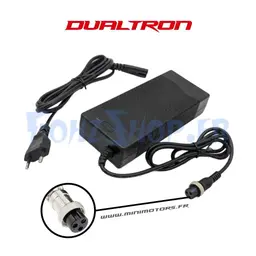
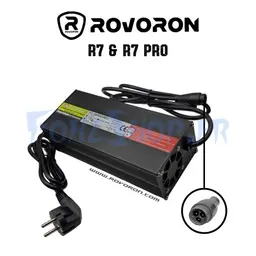
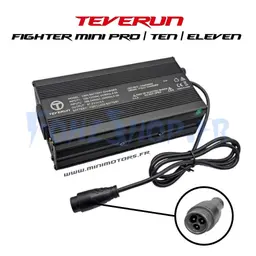
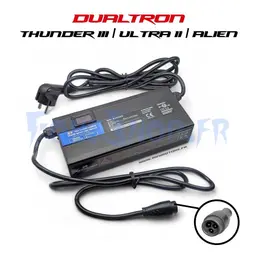
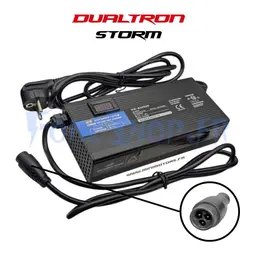
The same charger can come with different plugs. In our catalogue, the 66.4 V, 1.75 A Dualtron charger comes either with a round 3-pin GX16 plug or with a 3-pin LP16 plug, and each version has its own list of compatible models. The voltage alone is therefore not enough: you also need the right plug.
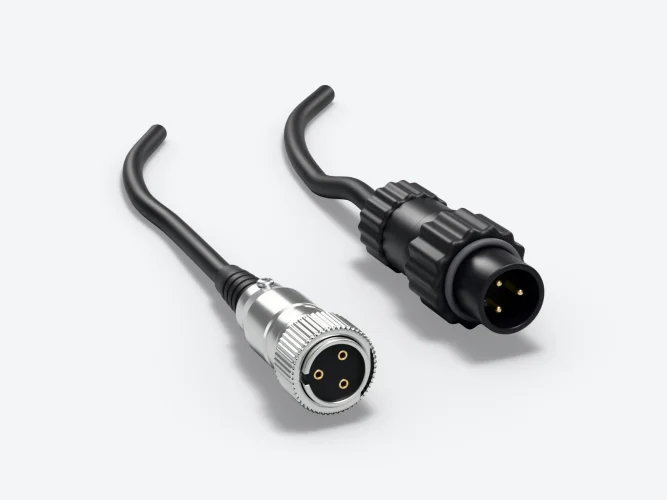
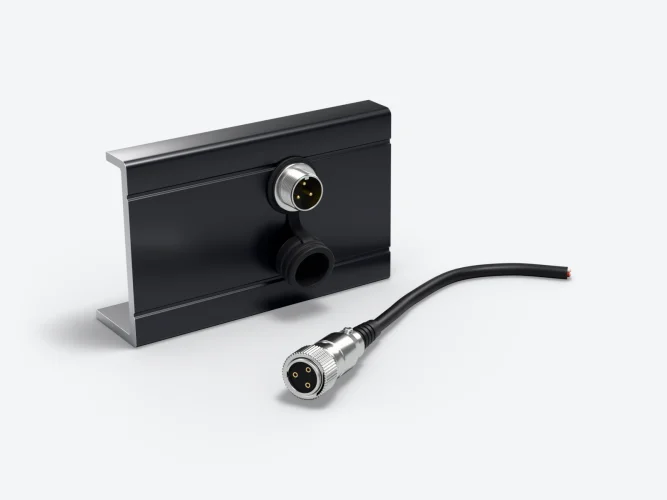
- Compare the plug with your charging port, cap open: shape, diameter and number of pins.
- Count the ports. The X Limited has two charging ports and two chargers[4]. The Sonic Alien has a two-in-one charging port that accepts two chargers[3].
- A small spark when plugging in can come from the voltage difference, and Minimotors considers it normal[5].
- Corroded or damaged terminals: stop charging and have the part replaced[5].
- Always close the cap on the charging port, both when riding and when storing the scooter[5].
A damaged plug is not repaired with tape. Our catalogue offers, for example, a replacement charger connector for Dualtron, Speedway, Blade and Rovoron, and a charger adapter for the Kukirin G2 Master, G2 Pro and G3 Pro.
Faulty scooter charger: how do you spot it?
| What you see | What it might be | What to do |
|---|---|---|
| Green light, but the battery is not charging | The charger stayed plugged into the wall for more than a minute without the scooter. Its protection then cuts the output[5] [6] | Unplug everything, wait more than 3 minutes[5], then plug into the scooter before the mains |
| Light off | No power, or a faulty charger | Check the wall socket, then stop using the charger and have it checked[5] |
| Charger dropped, hard knock, damaged cable sheath | Possible damage inside | Stop using it and have it checked[5] |
| Corroded or damaged terminals | Poor contact | Do not charge[5], have the connector or the port replaced |
| Charging takes far longer than your calculation | Charger delivering less than expected, or a tired battery | Try another identical charger, then have the battery tested |
Measuring the output with a multimeter, with the charger plugged into the wall but not into the scooter, can be misleading. On Dualtron and Rovoron scooters, the protection described above cuts the output after one minute without a scooter[6] [5]. A reading of 0 V with nothing connected therefore does not prove a fault. On the Sonic Alien, the voltage is displayed during charging[3]: if it rises, the charger is working.
The surest way to find out which is at fault, the charger or the battery, is to try another identical charger. Otherwise, have the whole set-up checked by one of our authorised repairers.
Charging safely: what the manuals say
- In the right order. Open the cap, plug the charger into the scooter, then into the wall socket[5]. Do not leave the charger plugged into the wall when it is not in use[5].
- In the right place. Never somewhere very humid, hot or confined, near flammable materials or without ventilation, such as a car. The charger is not waterproof[5].
- At the right temperature. 0 to 40 °C ambient temperature for the X Limited and the Rovoron R7[4] [5], -5 to 55 °C for the Sonic Alien[3].
- After the cold, wait. When you come in from the cold, wait one to two hours before charging, to avoid condensation inside[5].
- No riding and no forgetting. Do not use the scooter while it is charging, and unplug it when charging is complete: Minimotors mentions a risk of overcharging if charging lasts longer than the time stated in the specifications[5].
- Hold the plug. Unplug by the plug, not by the cable, and do not touch the plug for about ten seconds after removing it: it can still give you a shock[5].
Each manufacturer has its own rules, and your model's manual comes first. InMotion, for example, asks you not to charge the RS indoors[10]. For choosing a charging spot, keeping an eye on the charge and the signs of a damaged battery, see our article on the electric scooter battery.
Replacing your charger: the checklist
- Note the exact output voltage from the original charger's label, or from the manual.
- Note the current rating. Take the same for a standard charger, and a higher current only if it is the fast charger intended for your model.
- Compare the plug with your charging port: shape and number of pins.
- Check that your exact model, including its battery version, appears in the compatibility list on the product page.
- Work out the charging time you will get: capacity in Ah ÷ current in A.
Our chargers are in the chargers section, with the voltage and the intended models in their name. Here are a few of them, from the 66.4 V standard charger to the 95.4 V fast charger. To estimate how many kilometres you put back with each charge, see our article on electric scooter range.
Sources
- Molicel (E-One Moli Energy), Product data sheet, specifications and charge curve, checked 17 November 2026, Product Data Sheet, model INR-21700-P42A
- Minimotors (Dualtron), English-language manual, specifications p. 6, checked 17 November 2026, Dualtron Thunder 3, Product Manual
- Minimotors (Dualtron), English-language manual, pp. 4, 6 and 7, checked 17 November 2026, Dualtron Sonic Alien, Product Manual V2
- Minimotors (Dualtron), English-language manual, pp. 4, 6 and 7, checked 17 November 2026, Dualtron X Limited, Product Manual
- Minimotors (Rovoron), English-language manual, specifications pp. 5 and 6, charging pp. 17 and 18, checked 17 November 2026, Rovoron R7, Product Manual
- Minimotors (Dualtron), EY2 display manual, charging chapter p. 9, checked 17 November 2026, EY2, Important information
- Minimotors (Dualtron), English-language manual, specifications pp. 5 and 6, checked 17 November 2026, Dualtron Aminia, Product Manual
- Minimotors (Dualtron), English-language manual, specifications pp. 5 and 6, checked 17 November 2026, Dualtron City, Product Manual
- Minimotors (Rovoron), English-language manual, specifications pp. 5 and 6, checked 17 November 2026, Rovoron S7, Product Manual
- InMotion, English-language manual, specifications p. 10, charging p. 16, battery p. 24, checked 17 November 2026, InMotion RS, User Manual
About the author

Benjamin Gayaud
Managing director of FōhzShop
He runs FōhzShop and develops EyeX, the app for Dualtron and Rovoron scooters. He personally tests the electric scooters the shop sells.
Read next
Technical11 min read
Electric scooter controller: what it does, faults and replacement
The controller reads the throttle, the brakes and the motor sensors, then powers the motor over three phases. What it does, how to read its voltage and amperage, how to recognise a real fault and how to replace it without ordering the wrong part.
Technical14 min read
Electric scooter error codes: what they mean and how to fix them
E1, 80, 102, a red spanner or a thermometer: what each code shown on Dualtron, Rovoron, Odyssr, Teverun, Nami and InMotion displays means, according to their official manuals, with the part to check and what to do.
Technical12 min read
Dualtron electric scooter wiring diagram: how to read it and use it
Chinese and English labels, controllers, Hall sensors, wire colours, XT60 and board connectors: how to read the original wiring diagram for your Dualtron, use it to diagnose a fault and work safely.